Showing posts with label Cappadocia. Show all posts

Wednesday, January 11, 2012

Historical (in)Accuracy

clipart etc
ost everything I write has roots in some archeological site, artwork, or historical figure. I take what information I need and leave what I don't, which isn't easy. I want to honor the history, yet my story needs are different (and more important). It takes me a few days to process the research and pick out the suitable details. I don't pretend to write historical fiction. I write fantasy, yet what I keep usually rings pretty true. However...lately, I've been wondering just how far I'm willing to drift from my sources.

As far as accuracy of place, I try to be strong willed and make the story fit the landmarks. I don't change things. Two excellent examples of my reasoning:

1) Assassin's Creed-Revelations put a port in Cappadocia.
2)The International relocated Yerebatan Sarnici beneath the Blue Mosque.

Shifts like that irk me because I know better, and because those shifts mislead people. Many viewers or readers won't know the difference, and worse, they might take the information at face value. I suppose the important issue is exposing the public to the landmark, regardless of location, but it bugs me. Does it bug you?

I find historical figures are even more sticky to handle. So much so, I'm thinking to rename some major characters in Burnt Amber to avoid a big headache later.

Exhibit A:

The Turkish series I currently <3 <3 <3, Muhteşem Yüzyıl (Magnificent Century), featured Isabella Fortuna, Princess of Castile -  a whole subplot of her falling for Sultan Suleiman. Give me a break.

In fourteen hundred ninety-two
Columbus sailed the ocean blue.


That Isabella died in 1504. (I think they're referring to queen Isabella - I can't find evidence to the contrary.) What was she doing in Istanbul in late1526?

Don't screw with my head like that, people. Readers and viewers are not stupid, and we don't appreciate being misled. Although what worries me most is the idea that these inaccurate episodes may be the only history lesson people get about these rulers. At least give us a decent disclaimer. No?

So. Maybe I can and should go farther from my source than I thought, especially since I know accuracy is not all it seems to be either. Winners wrote their version of the story. What would the losers have to say?

I say creative license is a blessing. What say you?

Wednesday, January 4, 2012

Haystacks & Hydrangeas à la Assassin's Creed

True to Ezio's previous adventures, there are plenty of haystacks to hide in throughout Assassin's Creed - Revelations. True to Istanbul, there are also plenty of hydrangeas, or what the locals call hortensia (hydrangea macrophylla). Although I wouldn't want to be jumping into them like Ezio does, hortensia bushes in all shades of blue and lilac are found in parks and palaces across the city - in real life and in AC-R. Little details like this are the reason I enjoyed exploring the game.  
Here's my take on AC-R:

Topkapi Palace is detailed fairly well, as is the Grand Bazaar, and other landmarks like Hagia Sofia, the Galata Tower, and the Maiden's Tower. The rest of the city feels like any other AC game, except for the minarets. Tile roofs and towers, courtyards and caverns. The programmers threw in some carpets for effect, but it feels like Ezio could be anywhere, especially since the Bosphorus looks like a small river or maybe a Venetian waterway. (The Bosphorus is much wider in real life and you wouldn't want to swim across, my dear Ezio.)

But if you like Ezio's previous worlds, then the familiarity is a plus. (Even I can't really complain.) I was disappointed with the way programmers handled the Yerebatan Sarnici. They must have had plenty of leftover code and thought they could get away with chopping it up into sections. I can almost forgive them. There are plenty of cisterns under the city which might fit into their labyrinthine plan, and some of them must connect to Yerebatan Sarnici. What I don't accept is the way programmers handled the caves of Cappadocia.

Problem #1: There are no navigable rivers in Cappadocia, yet Ezio hops on a ship in Istanbul and lands right at the hidden entrance to a rock city.

Problem #2: The city is inside a huge cave. Correct me if I'm wrong, but the cities of Cappadocia are carved into cliff faces, or dug seven stories down like ground squirrel warrens. Supersized, giant caves? Felt like a device the programmers used so they could suspend a challenge from the ceiling. *ahem*

So besides hydrangeas and aptly placed white tulips, what did I love about AC-R?

wikia.com
Turkish is interlaced in conversation. Push someone as you run past and you might get a dose of interesting insults. Some of the women standing around have stories to tell about their lives too, if you listen. I think they used some native speakers because the accent was pretty pure.

Otherwise, the city folk are pretty standard. Instead of Venetian courtesans, we swap out a few dresses et voilà: Romani gypsies. Veiled women and turbaned men roam the streets in between groups of Ottoman Janissaries, who look pretty darned awesome in their detailed uniforms. I've got a thing for Janissaries though, so maybe it's just me. Uniforms aside, there isn't much difference between them and the Byzantines supporting theTemplars of the AC-R conflict. All guards act the same as any soldiers in previous AC games.

Bottom line: don't expect anything outrageously different from AC-R. Expect to spend some more time with Ezio Auditore da Firenze, relive a few scenes with Altaïr, and help Desmond out with the Animus.

You know what to you need to do. 

Psst...Go play the game! Desmond is up next. ;)


Friday, April 22, 2011

Cappadocia Cave Hotels

via Yunak.com
The Turkish cave hotel is my hands-down favorite boutique hotel experience. Ever. Look at the photo on the right...each room was originally a single family home in the cave house village. Now it's a furnished luxury retreat overlooking the moonscape of Cappadocia.

Yunak Evleri was even listed in The 1000 Places to See Before You Die, featured several times in Conde Nast, and countless other international magazines and newspapers.

There are other less expensive cave hotels in the towns all over Cappadocia and I recommend trying one of them instead of the giant tourist hotels on the outskirts.

Activites of the area are amazing - from the Goreme Valley Open Air Museum with UNESCO heritage site monasteries and frescoed chapels - to the hot air balloon rides, underground cities, wineries and carpet shops.

I had an entire chapter set in Goreme that got nixed from Burnt Amber, but I'm holding out for an opportunity to use the setting in another outline. It really is so bleeping inspiring.


Enhanced by Zemanta

Monday, February 21, 2011

Turkish Wine

Kavaklıdere winesImage via Wikipedia If you didn't get the chance to enter yet, there was a giveaway for a signed copy of Across the Universe in Friday's post. Go back and toss your name in the hat! I'm closing the entries tonight at midnight (blogger time stamp) and I'll announce the winner on Wednesday.

So since I just crossed the 200 follower threshold, I thought I'd celebrate today with a little bit about Turkish wine.... I'm not a connoisseur by any stretch of the imagination, but I do enjoy the occasional glass, especially from a boutique vineyard.

(Vineyards are lovely setting for any sort of mischief...no? Just wait till you see the ones in Cappadocia! Early Chirstians were making wine in the underground cities there centuries ago.)

A little more history:

With the rise of the Islamic Ottoman Empire, winemaking in Turkey experienced a significant decline. Then in 1925, Ataturk (the first Turkish President) opened a state run vineyard and over the years, it's become a more viable business for entrepreneurs. Some successful Turkish wineries include Sarafin from the region of Thrace and  Kavaklidere from Cappadocia. Stateside, Total Wine stocks Kavaklidere for between $12-14 a bottle online.

Unique red varietals include:

Öküzgözü (ox eye): This unique ageable dry red wine – Öküzgözü ages well up to 10 years – has a bright red color, reveals intense fruity flavors of raspberry and cherry, and is rich with a well-balanced body with light tannins. The alcohol ratio of wine is between 12 - 13%. Öküzgözü is best served at 16-18 degrees C (61–64 degrees F) and is a perfect match with different dishes served with a cheese sauce, casseroles, red meat, grills, cheese and poultry. (wikipedia)

Boğazkere: The characteristics of this wine is strong body, very enjoyable long finishing, dark red color with dark blue hue, very rich and strong aromas of dried red fruits, spices. Good for aging up to 10 years. Recommended with red meat kebabs, turkey, salmon and cheese. Especially eastern Anatolian cheddar or Gruyere cheese. (again, wikipedia)

Winemakers grow standards as well, blending Anatolian varieties with European varieties like Shiraz, Pinot Noir, and Cabernet. A popular white is Narince, which is Chardonnay-like, supposedly with notes of fruit and white flowers. It's often mixed with Semillon grapes.

Here's a CNN report about the Revival in Turkish Wine:


I'll toast to that! Şerefe! (Sheh-re-fe)

Thursday, September 2, 2010

Underground Cities

Kaymaklı Underground City - Cappadocia, TurkeyImage via Wikipedia
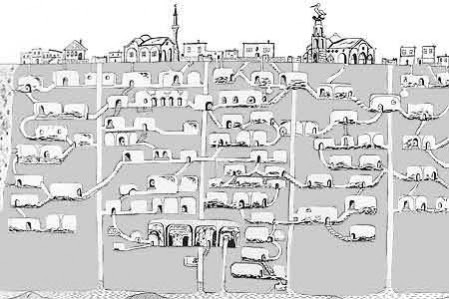
Lots of us were enthralled with City of Ember recently and even Mockingjay went subterranean, but did you know about the real underground cities in Turkey? There are hundreds in the Cappadocia region of the Anatolian plains. Derinkuyu is the largest city, with an estimated eleven levels that once housed thousands of people. The city is connected by tunnels to another at Kaymakli. These two cities are the only ones open to tourists today and require a guide for exploration.

Originally created by 7th and 8th Century Phrygians, the cities were also used by Hittites and most famously by early Christians hiding from the Romans. The Christians expanded what was already existing and carved rooms for different purposes.  Visitors tour store rooms, wine presses, graineries, stables, school rooms and even a church at the lowest level.  Watch for the heavy doors, like giant 200-500 kg millstones, designed to block out enemies. Once inside, inhabitants relied on a deep well (85 m or about 250 ft at Derinkuyu) for water and various ventilation shafts for air. Invaders couldn't come in, so they typically tried to flush the people out by poisoning the wells.

I technically don't have claustrophobia. However, I learned to appreciate the concerns of friends who are...very quickly... as I descended into the rabbit's warren of tunnels better suited for ground squirrels than me.  This is a map of Derinkuyu.  Believe me, you do not want to loose sight of your guide.


The electric lighting in the tunnels is barely enough to keep the creepy feeling away.  I can't imagine what it was like when people had to wander around with a candle!

Since touring an underground city is pretty much unforgettable, you won't be surprised that I got inspiration from it for Burnt Amber. Ifrit djinn like to live underground and in ruins, so an underground ruin is a great place to find one, if you're looking. I had a whole chapter devoted to Cappadocia, but telescoped it into the chapter with the cistern to keep the pace moving along.

Here's a clip of my new Facebook friend Teresa the Traveler touring the tunnels. Enjoy!

Enhanced by Zemanta

Tuesday, August 3, 2010

I Put Flying Carpets to Rest

There are no flying carpets in Burnt Amber, sorry to disappoint. I know, Aladdin has one and its all geniefied and yeah its cool.  Remember last week I said djinn are not blue? Well this week I'm blasting flying carpets out of the water.  Djinn do not need them...at all.

But while carpets are not necessary to djinn, they are an important part of Turkish culture. And the carpet designs are not just pretty, there is meaning attached to each knot and color choice.  Visit Istanbul's famed Grand Bazaar , sit down for a cup of yummy elmali çay (apple tea) and a carpet dealer will happily spend your entire afternoon explaining.  There are a few designs in particular I love, the tree of life (a persian motif usually though) and the center medallion.  I almost included a tangent about the medallion for Sybil, maybe I'll still find a way, since I think it's interesting. The medallion represents the earth and the levels of heaven are represented by....I digress. 

Important point : Ottoman sultans relocated the finest weavers to Hereke so they could furnish their palaces. Weavers there still make intricate silk on silk carpets fine enough to hang on a wall as artwork.  Of course, the traditional wool Turkish carpet or flat weave Kilim is nice for that too.  Even with the modern decor so popular in Turkey today, most homes have at least one piece someplace.  Once you get hooked, you'll never buy a machined carpet again, I promise.  Even the ones at IKEA are better than nothing.

Courtesy of Teresathetraveler, we have a brief and informative visit with a carpet dealer in Goreme, which is where I got my Toros carpet (above) as a wedding gift, btw.


Enhanced by Zemanta

LinkWithin

Related Posts with Thumbnails