Wednesday, March 16, 2011

Cilician Pirates

Alanya in Turkey on the Kitab-ı Bahriye (Book ...Image via Wikipedia
This here is a partial map of the coast near Alanya, drawn by Ottoman cartographer, Piri Reis, sometime between 1465 and 1555. As you can see, besides the two castles at the points, there is little in between. It's still pretty much the same today, and if we go back to the first century BC, the only major difference is that the castles were smaller. An extremely craggy coastline is apparently deterent to urban sprawl. (Yay for that!) 

The Taurus mountains (pictured on the right edge) cut the area off from Anatolia on the one side and come sprawling down to the sea on the other. Spectacular coves and views result, but as I learned, the zigzag on the map means the distance from A to B is increased exponentially.

(Please don't ask me about the hours I spent, white-knuckled, on a two lane road which barely hugged the mountain, watching the locals zip past at light speed before they whipped around the hairpin turns in a scene reminscent of a mad rally car race. Just don't.)

Anyway, back to the purpose of the post - Roman era PIRATES!

via LycianTurkey.com
Take a look at Cilicia Trachea (rocky Cilicia) in the photo on the left. Gorgeous, isn't it? I'm not the only one who saw possibilities here.


Coves for hideouts + plentiful supplies for ship building = heaven for rogue Seleucid, Diodotus Tryphon, and lots of his pals. (Strabo called him the first Cilician pirate.)


Back to the map...
  1. Point A :Coracesium (modern Alanya), the big castle and the impenetrable main fortress of the pirates. (Separate post, I promise.)
  2. Smooth curve (which we know is actually quite jagged. Piri Reis probably didn't want to get snagged by the rocks, hence no detail.) 
  3. Point B:Mamure castle, (the whimpy one at the bottom), built by the Romans to fight them.
No wonder the Romans weren't very successful, but then their heart wasn't in it either. Pirates were useful to the Roman slave trade, even if they did screw up the grain markets with their continuous pilfering. Cilician pirates especially were living the high life. They mocked Rome, offering protection and seeking welcome in every port of call as they inched toward the Apennine peninsula.
 
This via wikipedia: Plutarch recounts a particular custom of the Cilician pirates. When a prisoner of theirs called out he was Roman, the pirates would pretend to be scared and beg for mercy. If the prisoner took the pirate's mockery in earnest, they would dress him in Greek athletic shoes and a toga, that they might not repeat the mistake. After they were satisfied mocking him, they would lower a ladder into the sea, and, wishing him a fortuitous journey, invite him to step off. If the man wouldn't go of his own accord, they would push him overboard.

However, some (stupid) pirates got a little ambitious when they kidnapped Julius Caesar - twice.
 
The first time the pirates ransomed him for 500 kilos of silver, the second time they got a thousand. Julius Caeser didn't like the pattern he was seeing. He hopped on a war ship, defeated the responsible parties and crucified them. (We're probably being literal with that term.) Eventually, the Cilician menace pissed off enough Romans to warrant a true fight. The pirates tried not to engage, but they were disbanded and shipped off to farm the lands of inner Anatolia, as far from their beloved sea as possible. 
 
Ahhhh....hubris!

So...why am I interested in this right now? Alanya/Mamure/and the Cilician coast, are my next story stop. Guess who I need to work in? The character is already coming together in my head - if I just give him a name, I'm sure he'll show himself. I think I'm really going to like him. :)

Any ideas on a good modern name for Tryphon?
Enhanced by Zemanta

Monday, March 14, 2011

Paring it Down

via tasteoftanzania.com
Last Monday I wrote about olives (because I just couldn't think of anything exciting) and you loved me anyway. Thanks!

Anyhow, Jacqueline Howett shared her experience with olives: On our vactions from England to Greece to visit my Yaya who lived in a olive grove, we got stuck with the chore of slitting each olive with a knife for selling to market.

That comment got me nostalgic for the days I spent with the other women of my husband's Turkish family, coring, chopping, and preparing all sorts of veggies for the dishes we created. We sat around the table in the kitchen or out on the balcony, drank lots of tea, and read many fortunes. Don't get me wrong, I love climbing ruins and all that...but this one rite of passage into the lives of my in-laws was priceless.

Not only did I learn to make some yummy things, I also got an earful of stories. (And sagas, but we'll pass on those for today.) Little tips, like rubbing the tomato with the flat side of the knife before peeling to release the skin. (I blanche mine now. Tomatoes here aren't the same.) Or, my favorite: Put your thumb at the base of the blade, so the knife doesn't come out the other side of the (baseball-sized) eggplant. And the one I won't ever forget - Just because the chile seeds aren't burning you right now, doesn't mean they won't. (Spent several hours dipping my digits in ice water for not listening to that!)

Some days, ana anne (grandmother) would open out the dough for manti (imagine tortellini). Believe me, stuffing one million teeny strips of dough with meat is more fun when you have help.Then there were the dilemmas: aunt x says to use paprika, mother-in-law says cumin is better. I don't like cumin. Use paprika. Pay dearly. Yes, I laugh about it today, but it wasn't so funny then.

Just like with fishing, carefully paring the tops off okra the size of my thumbnail, without breaking into the seeds, taught me something. If you want to absorb another culture, it's important to slow down and smell the spices.
Enhanced by Zemanta

Friday, March 11, 2011

Mamure Castle

via travelpod.com
Can you believe I missed going inside this castle? Yes - stupid me - I was too tired that day. I had the most amazing chicken kebab at a restaurant down the beach from it, though...with a breathtaking view. Luckily, Anamur it isn't far from Mersin, so I can get back there the next time I go to Turkey.

Here's the 101 on Mamure Castle according to wikipedia:

The castle was built on the foundation of an ancient castle built by the Roman Empire in the forth century, undoubtedly against pirates. 

-blah de blah de blah - lots of guys fought over it, it changed hands several times - fast forward :

In 1475, the castle was annexed by the Ottoman Empire. During Ottoman reign, the castle was repaired in the 15th, 16th and 18th centuries and a part of the castle was used as a cervansarai.

Love the part about the pirates... (I keep looking for a way to use that! I promise I'll get you some more posts on them soon.) ...and Mamure must have been the most awesome caravanserai stop. Can you imagine stopping there for the night to rest your tired, laden *erm*camel? (Monty Python fan here.) OK, so maybe it was a little smelly, but there's a killer view. (mamure = prosperous, btw.)

So why is Mamure castle special?

Let's break it down. I always write about the stories behind a castle, but in this case I need to point out the parts. Mamure is known for it's spectacular crenellation.

Take it away wiktionary:

Crenellation

1. A pattern along the top of a parapet (fortified wall), most often in the form of multiple, regular, rectangular spaces in the top of the wall, through which arrows or other weaponry may be shot, especially as used in medieval European architecture.
2. The act of crenellating; adding a top row that looks like the top of a medieval castle.

It's nice to find a ruin that isn't so...well...ruined...isn't it?


Enhanced by Zemanta

Wednesday, March 9, 2011

Telescoping


via potterybarn.com

I shy away from posts about craft because, let's face it, I'm the noob around here...but I wanted to share something I learned from a writing power greater than myself (Tracy Marchini). This one trick she suggested waaay back in my first draft is the single most important thing I learned.

Telescope: Slide one element into another and strengthen the story.

  • Telescope scenes to keep pacing strong.
  • Telescope characters to create complexity.
  • Telescope plot to keep tangents at bay.
  • Telescope sentiments to increase tension.
I don't know if telescoping is an official writerly term or anything, but I like it. My secondary character/trickster, Seyhan, was three separate guys at one point. (Talk about a personality disorder, lol!)


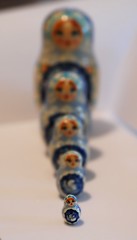
Matryoshka doll from UkraineImage by yasmapaz & ace_heart via Flickr
At first I couldn't see how to do it, but when I took away individual traits that didn't mesh, it worked out. Very well. So well that I couldn't stop myself from telescoping whenever I found a dry spot in the pacing, a darling floating in a paragraph on its own, a plot twist that needed more twisting... All those things didn't just jumble together either. They became clearer, as if I pulled them in for a closer look. I liken the theory to the Matruska doll of parallel universes. (Today's tie-in. :D) Multiple realities are layered into one whole which is greater than the sum of the parts. (Either that, or I should get out and smell the whatever-is-blooming-right-now. I've been in this chair too long. Do these words look like they're snaking around the page to you?)

Of course, I probably wouldn't have been able to telescope anything if I hadn't first poured it all out onto the page in the unadulterated first draft. I was hoping to avoid this step in my second ms, but now I realize a vital part of my writing process is the exploration of the story in long-hand.

Does anyone have tips on telescoping more efficiently?

Monday, March 7, 2011

Olives - Oil Cured vs Brined

Yesil zeytin 1Image via Wikipedia
Growing up, I hated olives. With a passion. The only olive I liked was my Great Aunt Olive. (She brought me cool Beatrix Potter stuff from England. I also would have appreciated Olive, The Other Reindeer, but she wasn't around.)

The only olives my New England Yankee/Polish Immigrant family knew were the canned black variety that resembled (and tasted like) rubber washers.... or the equally offensive green kind stuffed with red pieces of something-or-other. Every holiday, I passed the obligatory olive/gherkin dish around and prayed the smell wouldn't make me hurl.

Enter my Turkish mother-in-law.

Kahvalti (Turkish breakfast) was her thing. She made homemade cheese (don't even ask how that smelled), blended her own teas, and insisted I try the olives. Wrinkly, shiny, weird-as-hell looking salt cured olives. With pits even! Of course, my DH just laughed at me when I objected.

Fast forward many years and I've made my peace with olives. Seems not all of them taste like rubber. :) In fact, sometimes you'll see me standing at the chichi olive bar choosing between a dozen varieties.

Here are some pointers I used to get myself past the can/jar.
    
    via Tulumba.com
    
  • I stay away from the bitter green varieties because the curing process usually involves lye. They say it all gets rinsed away, but I like to play it safe. (Yes, lye from the cleaning aisle. Yuck! And yet, before I knew this, I did eat green olives...)
  • Black, oil-cured olives are salty and wrinkly. They have the strongest flavor (which I actually like these days) and don't keep very long. I only buy small batches. There's nothing I hate more than a mushy olive. *shivers*
  • Brined olives are cured in salty water for a few weeks. A good example is a Kalamata. These generally have the most fruit on the pit, no matter what size you choose. They're the most versatile.
  • Marinated - in vinegar and olive oil, sometimes with garlic and herbs. These can get too funky for me, but sometimes I'll find a nice one. I like when they toss in some big capers. Those are yummy.
An olive bar usually features olives from various locations and varieties (ie France for the petite picholine, Greece for kalamata, etc.), and producers who like to have fun with the marinades. A good deli will let you try before you buy.

Enhanced by Zemanta

Friday, March 4, 2011

Cercis Siliquastrum aka Erguvan, or in other words...Redbud Tree

via sinanbaslas.com
The other day, Anonymous stopped by and left a comment on my post about Boğaziçi University. (For newcomers, BU is the setting for my novel.) Anonymous pined for the lovely campus of his/her alma mater and reminded me of how beautiful the erguvan trees are in the spring. Of course, I'm a sucker for flowering anything, and Istanbul in bloom is just breathtaking. How could I not mention it in my writing someplace? (It's in chapter two of Burnt Amber, btw.)

So what is an erguvan tree? Cercis siliquastrum, aka the redbud tree. The Bosphorus strait is dotted with redbuds for a few weeks in late April/early May. Some areas, Bebek included, have pockets of the trees like the one in the picture. It's no wonder that Roxelana's favorite color was erguvan mauve. There was nothing the Ottomans didn't have in that color.

Here in the Carolinas, we have its cousin, native cercis canadensis, blanketing our hillsides. Dainty blooms, ornamental seed pods and pretty heart shaped leaves make an attractive tree, so redbuds are popular in gardens of the southeast and all the way up into southern New England. When my grandmother passed away I planted a dwarf weeping variety called "Covey" at my old house in New Haven. I also have several of the burgundy leaved "Forest Pansy" variety in my new backyard. Currently, I'm coveting a new variety borne of "Forest Pansy" and "Covey", "Ruby Falls", which both weeps AND has beautiful burgundy foliage. I just need to find that sweet spot for it.

Fun note:

Green twigs have been used in southern Appalachia to season venison for years, so the tree is also known as spicewood up in the mountains. Native Americans ate the buds raw or boiled and roasted the seeds. I haven't tried any of these recipes, but some buds might look pretty on top of a salad...
Enhanced by Zemanta

Wednesday, March 2, 2011

Labyrinthine

via Wikipedia
I'm busy with the Crusader Challenge and my google reader is about to explode. I need to find a way to organize all the new blogs I'm following. (Any tips appreciated!)

Meanwhile, Blogger is making me insane with all its convoluted words. I feel like I'm on a scavenger hunt for rss feeds and follower buttons. So since I've been meaning to write about labyrinths, today felt appropriate. :)

The maze is a traditional symbol for finding the divine or the self. We authors take characters through a labyrinth each time we give them a goal to accomplish or a MacGuffin (thanks, Matt :D) to locate. 

Underground cities, castle dungeons, serpentine streets, yellow brick roads...all of them work well and lots of writers (including me) use them at particularly difficult moments in a character arc. Movie directors like them too because true labyrinths are visually striking. My favorite is aptly titled Labyrinth, with David Bowie and Jennifer Connelly. I just thought I'd share the particularly poignant lyrics of the movie song, Within You. It illustrates both the internal and external labyrinths of the story.

How you turn my world

You precious thing.
You starve and near exhaust me.

Everything I've done,
I've done for you.

I move the stars for no one.

You've run so long.
You've run so far.

Your eyes can be so cruel,
Just as I can be so cruel,

Oh I do believe in you.
Yes I do.

Live without your sunlight.
Love without your heartbeat.

I... I...
Can't.. live.. within.. you...

I can't live within you

I...I..Can't live within you

And here's the visual, Escheresque stairs and all...


Enhanced by Zemanta

LinkWithin

Related Posts with Thumbnails